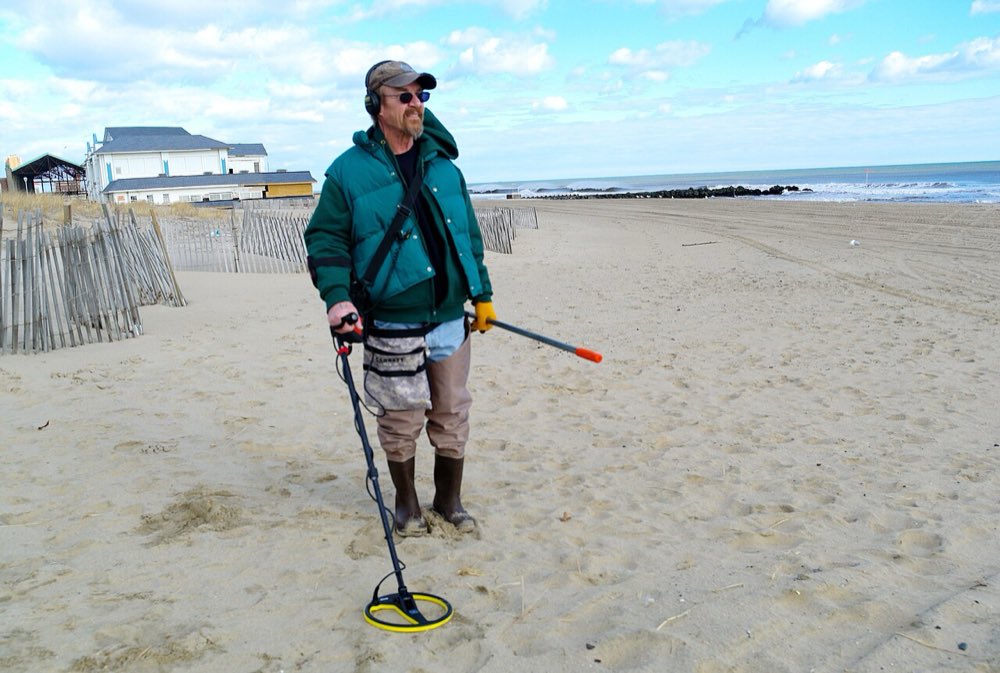
On a beach, a spade is almost useless. Wet sand slumps back into the hole, and in the shallows you can’t see what you’re digging. A sand scoop solves both problems: you lift the whole target area out in one go and shake the sand through the holes until only the find is left. It’s the one accessory every beach detectorist ends up buying.
How we chose: from product specifications, current Amazon UK prices and ratings, and what beach detectorists say about durability. We haven’t tested every scoop ourselves.
The short answer
- Best overall: stainless steel scoop with long anti-slip handle (about £38). The most-reviewed stainless scoop on Amazon UK.
- Best budget: INCLY plastic sand scoop and shovel (about £17). Great for dry sand and for children.
- Best for wading: fibreglass-handled stainless scoop (about £36). Long handle, detachable short grip.
- Best adjustable: telescopic stainless scoop (about £36). Adjusts in length for wet sand and shallow water.
Stainless steel or plastic?
| Stainless steel | Plastic | |
|---|---|---|
| Wet, packed sand | Cuts in easily | Struggles |
| Shingle and stones | Survives | Can crack |
| Weight | Heavier | Light |
| Detector interference | Keep it away from the coil when checking | None |
| Price | £25-£40 | £10-£20 |
For most UK beaches, where you’ll be working wet sand and shingle, a stainless steel scoop is worth the extra. A plastic scoop is fine for dry sand and makes a good second scoop for children.
Long handle or short?
A long-handled scoop (1m or more) lets you work standing up on wet sand and in the shallows. It’s much easier on your back and essential if you wade. A short-handled scoop is lighter and easier to carry, but you’ll be kneeling for every target. Many detectorists prefer a long handle with a detachable short grip, which gives you both.
The best sand scoops
Best overall: stainless steel sand scoop with long anti-slip handle (about £38)
A stainless scoop on a long handle with an anti-slip grip. It's the best-reviewed stainless sand scoop on Amazon UK, rated 4.5 stars from over 1,000 ratings, and a sensible all-rounder for wet sand and shallow water.
Best budget: INCLY sand scoop and shovel (about £17)
A one-piece heavy-duty plastic scoop with 129 sifting holes, plus a small shovel. The plastic doesn't interfere with your detector when you check the scoop. It's best on dry and soft sand, and a good choice for children. Rated 4.6 stars from over 1,000 reviews.
Best for wading: stainless scoop with long fibreglass handle (about £36)
A stainless 11 x 6-inch basket on a long fibreglass handle, with a detachable short handle with a rubber grip for kneeling work. Fibreglass is light and doesn't corrode in seawater. Rated 4.5 stars from 26 reviews.
Best adjustable: telescopic stainless sand scoop (about £36)
A stainless scoop on a telescopic handle, so you can shorten it for travelling and lengthen it for the surf. Rated 4.1 stars from 31 reviews. As an Amazon Associate we earn from qualifying purchases.
How to use a sand scoop
- Pinpoint the target with your detector, then place the scoop just behind it.
- Push the scoop in and lift in one smooth movement, taking the target area with it.
- Shake the sand out through the holes. In water, swirl it.
- Check the scoop with the detector. If the signal’s in the scoop, tip the contents into your hand. If not, it’s still in the hole, so scoop again.
- Fill in your hole before you move on, even on the wet sand. Holes are a hazard for walkers and horses.
A waterproof pinpointer makes step 4 much faster. See our pinpointer guide.
Where you can detect on beaches
Much of the foreshore in England, Wales and Northern Ireland is managed by the Crown Estate, which allows detecting on it subject to its terms. Council and private beaches may have their own rules, and National Trust beaches are off limits. Treasure rules apply on the beach too. See our beach detecting guide for more.
Frequently asked questions
Is a stainless scoop worth it? On UK wet sand and shingle, yes. Plastic scoops struggle with packed wet sand and can crack on stones.
What size holes should a scoop have? Holes of roughly 1cm let sand through quickly but keep rings and coins. Very large holes can lose small gold.
Can I use a sand scoop inland? Not really. It’s designed for sand and shallow water. Use a detecting spade on farmland. See our spade guide.