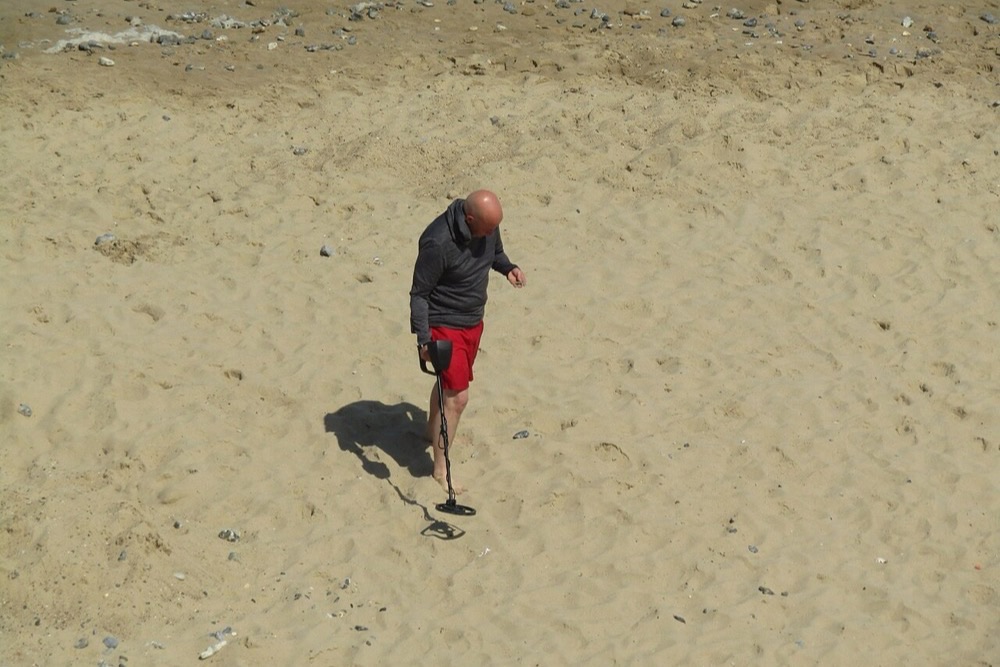
Yes, you can metal detect on most UK beaches, but whether you can detect on a particular beach depends on who owns that stretch of sand. The tidal foreshore is often owned by the Crown Estate, which lets people detect without a permit. The dry beach above the tide line usually belongs to the council or a private owner, and they set their own rules. A few beaches are off limits altogether.
This guide covers who owns what, the rules for each type of beach, the differences in Scotland, Wales and Northern Ireland, and what you have to do with your finds.
The short answer
- Crown Estate foreshore (England, Wales and Northern Ireland): yes, without a formal permit, as long as you follow its terms and the Treasure Act.
- Council beaches: usually yes, but check first. Councils can ban detecting with byelaws or ask for a permit.
- Private beaches: only with the owner’s permission.
- National Trust beaches: no, except approved archaeological projects.
- The Thames foreshore in London: only with a Port of London Authority permit.
- Protected sites (SSSIs, scheduled monuments, military ranges): no, unless you have specific consent.
Who owns the beach?
A beach is usually two pieces of land with different owners:
- The foreshore is the strip between mean high water and mean low water, the part the tide covers and uncovers. The Crown Estate owns around half of it in England, Wales and Northern Ireland. The rest belongs to councils, harbour authorities, private estates and organisations such as the National Trust.
- The dry beach above the high-water mark, including the soft sand, dunes and shingle banks, is a separate piece of land. It’s usually owned by the council or a private landowner, and Crown Estate permission doesn’t cover it.
To check who owns a stretch of foreshore, use the Crown Estate’s foreshore and estuary ownership map, which is linked from its metal detecting page. For the dry beach, the council’s beach or seafront team is the quickest first call.
Crown Estate foreshore: the rules
The Crown Estate says you can detect on its foreshore without formal consent, subject to its terms and conditions. In practice that means:
- Foreshore only. The permission covers the land between mean high and low water. It doesn’t cover the seabed below low water, riverbeds or other Crown Estate land.
- Hand tools, surface searching only. No mechanical digging. Fill in every hole.
- The Treasure Act applies. The permission depends on you reporting potential treasure.
- Other people can still restrict it. Businesses that lease foreshore from the Crown Estate, nature designations and local byelaws can all limit or ban detecting on a particular stretch.
- Finds belong to the landowner. The Crown Estate says finds above the low-water mark are generally the landowner’s property, unless they’re treasure.
Council and private beaches
Most popular seaside beaches are run by the local council, and the rules vary from one council to the next. Some allow detecting freely, some ask you to apply for a permit, and some ban it with a byelaw. Folkestone and Hythe District Council, for example, publishes its own metal detecting policy. Search the council’s website for “metal detecting” or ask the seafront office before your first visit.
On a privately owned beach, you need the owner’s permission, just as you would on farmland. Our permission guide covers how to ask.
Beaches where you can’t detect
- National Trust beaches. The Trust doesn’t allow metal detecting on its land, including its beaches, except as part of approved archaeological projects.
- Protected nature sites. On Sites of Special Scientific Interest and Marine Conservation Zones you may need consent from Natural England, Natural Resources Wales or the Northern Ireland Environment Agency before you detect.
- Scheduled monuments. Using a metal detector on a scheduled monument without consent is a criminal offence, and some coastal forts and settlements are scheduled.
- Military land. Coastal firing ranges are off limits, and unexploded ordnance does turn up on some beaches. If you find anything that looks like ammunition, leave it and call 999.
The Thames and tidal rivers
Crown Estate permission doesn’t extend to riverbeds. The Thames foreshore in London needs a separate permit from the Port of London Authority, and some stretches have extra restrictions or bans. For other tidal rivers and estuaries, check who owns the foreshore before you detect.
Scotland, Wales and Northern Ireland
- Scotland. Around half of Scotland’s foreshore is managed by Crown Estate Scotland, and Scottish heritage guidance says you don’t need its permission to detect there. The big difference is the law on finds: under Treasure Trove, every archaeological find must be reported, not just treasure. See our Scotland guide.
- Wales. The Crown Estate foreshore rules are the same as in England, and the Treasure Act applies. See our Wales guide.
- Northern Ireland. Digging to search for archaeological objects needs a licence under the 1995 Order, which applies on beaches too. Read our Northern Ireland guide before you go.
What to do with beach finds
- Possible treasure: gold and silver objects over 300 years old, and groups of old coins, must be reported to the coroner within 14 days in England, Wales and Northern Ireland. Your local Finds Liaison Officer can do this for you. Our guide to finding treasure explains the process.
- Wreck material: anything from a ship that washes up in tidal waters, such as a porthole, a bell or cargo, must be reported to the Receiver of Wreck within 28 days, under the Merchant Shipping Act 1995.
- Other old finds: record them with the Portable Antiquities Scheme, even when you don’t have to. It’s free and it helps archaeologists understand the coast.
- Modern finds: most beach finds are lost coins, keys and jewellery. Under the Crown Estate’s terms, finds on its foreshore are generally the landowner’s property, so a valuable modern find, such as a ring, is worth handing in to the police in case the owner is looking for it.
Kit for the beach
Wet salt sand confuses many basic detectors, so a machine with a beach mode makes a real difference. A sand scoop is far quicker than a spade on the beach. See our beach detector guide and sand scoop guide for the full comparisons.
Best all-round beach and land detector: Minelab Vanquish 340 (about £199)
The Vanquish 340 has a dedicated Beach mode and Minelab's Multi-IQ multi-frequency technology, which gives it the stability on wet salt sand that single-frequency detectors struggle with at this price. The coil is waterproof, but the control box is only water-resistant, so it's for the beach itself, not for wading. If you'll detect both fields and beaches, it's the best value choice. It's rated 4.3 stars from 703 Amazon UK reviews.
Best overall: stainless steel sand scoop with long anti-slip handle (about £38)
A stainless scoop on a long handle with an anti-slip grip. It's the best-reviewed stainless sand scoop on Amazon UK, rated 4.5 stars from over 1,000 ratings, and a sensible all-rounder for wet sand and shallow water.
Before you go: a quick checklist
- Check who owns the foreshore on the Crown Estate’s map.
- Check the council’s rules for the dry beach, and look for byelaw signs at the entrance.
- Make sure the beach isn’t National Trust land, a scheduled monument or a protected site.
- Take a bag for rubbish. Beaches are full of ring pulls and foil, and taking them away is good for everyone.
- Fill your holes, and give sunbathers plenty of room.
- Get public liability insurance. Our insurance guide covers the options.
Fancy the T-shirt? We've made a small range of metal detecting slogans, from "Beep Dig Swear" to "Professional Ring Pull Collector", on T-shirts, hoodies, mugs and stickers. See the metal detecting designs on Redbubble.
These are our own designs, printed and sold by Redbubble. We earn a small margin on each sale.
Frequently asked questions
Do I need a permit to metal detect on a UK beach? Not on Crown Estate foreshore in England, Wales or Northern Ireland, which allows detecting without formal consent subject to its terms. Some councils require a permit for their beaches, and the Thames foreshore needs one from the Port of London Authority.
Can I keep what I find on the beach? Finds generally belong to the landowner, unless they’re treasure. In practice most detectorists keep everyday finds, but potential treasure and wreck material must be reported by law. Note that the beach itself is a separate question: removing pebbles, shingle or sand can be an offence, which we cover in can you take pebbles from UK beaches.
Can I detect in the sea? The Crown Estate’s permission covers the foreshore, between high and low water, and not the seabed below the low-water mark. Wading at low tide on the foreshore is fine. Go further out and you’re beyond that permission.
Can I metal detect on National Trust beaches? No. The National Trust doesn’t allow metal detecting on its land, beaches included, except for approved archaeological projects.
What’s the best time to detect a beach? Low tide, after a storm or a run of strong winds, when the sand has been stripped back. Our beach detector guide has more tips for a first trip.