Your first few outings will produce a pouch full of odd bits of metal, and most of it will be rubbish. But mixed in with the ring-pulls are things that are hundreds or even thousands of years old, and learning to recognise them is half the fun of the hobby. Here are the finds UK detectorists turn up most often, roughly from most common to least.
Modern rubbish (you’ll find lots of this)
- Ring-pulls and can tabs. The classic detectorist’s find. They give a signal a lot like gold, which is why most detectorists dig them anyway.
- Foil, bottle tops and scrap. Take it home and bin it.
- Shotgun cartridge caps. The brass ends of shotgun cartridges turn up on almost every field.
- Iron. Nails, bits of farm machinery, horseshoes and wire. Most detectors can be set to ignore a lot of it.
Everyday historic finds
| Find | Roughly how old | How to recognise it |
|---|---|---|
| Buttons | Mostly 17th–19th century | Flat copper-alloy discs with a loop (shank) on the back. Some have makers' marks or livery designs |
| Musket balls and lead shot | Mostly 16th–19th century | Round lead balls, often with a seam or a flat spot where they hit something |
| Lead weights and fishing weights | Medieval to modern | Lead lumps, discs or cones, sometimes with a hole |
| Victorian and Georgian coppers | 18th–19th century | Large copper pennies and halfpennies, often very worn |
| Buckles | Medieval to 19th century | Copper-alloy frames, often broken. Shapes change a lot over time, which helps with dating |
| Thimbles | Medieval to modern | Small copper-alloy thimbles with dimpled surfaces, often squashed |
| Crotal bells | Mostly post-medieval | Small round bells with a slot, once used on horse harness and livestock |
| Tokens | Especially 17th century | Small coin-like pieces issued by traders, often with a name and town |
The finds everyone hopes for
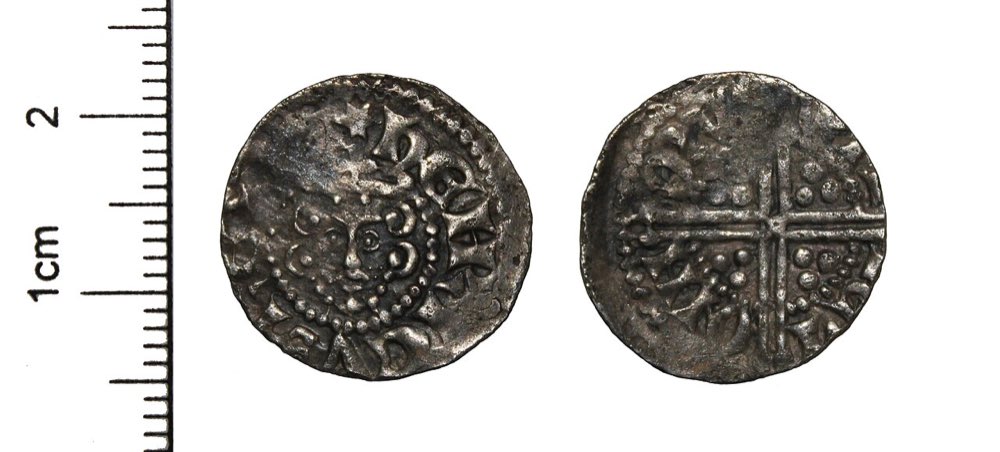
Hammered coins. Before milled coinage took over in the 17th century, English coins were struck by hand with hammer and dies. Hammered silver pennies, groats and their cut halves and quarters are the finds many UK detectorists prize most. They’re usually thin, irregular in shape, and often show a cross on the back.
Roman coins. Small bronze Roman coins, many from the 3rd and 4th centuries AD, are among the most common ancient finds in England. They’re often dark and worn, and detectorists nickname them “grots”. Silver denarii and siliquae turn up less often.
Brooches. Roman bow brooches, Anglo-Saxon brooches and medieval brooches are all found by detectorists and are very collectable.
Medieval and later jewellery. Rings, pendants and dress fittings, occasionally in gold or silver.
Could it be treasure? Gold and silver objects over 300 years old, and some other finds, may legally count as treasure and must be reported within 14 days. See our treasure guide. And don't clean old finds. It can destroy detail and value. Our cleaning guide explains why.
How to identify what you’ve found
- Search the Portable Antiquities Scheme database. The PAS database at finds.org.uk contains well over a million recorded finds, with photos and descriptions. Search for the type of object and browse similar examples.
- Show it to your Finds Liaison Officer. FLOs identify and record finds for free, and you get your find back. It’s the best way to put a date on an object and add it to the historical record.
- Ask at your club. Experienced members have usually seen it before. See our guide to clubs.
- Use a good reference book. Two standard references for UK detectorists are below.
Identifying Detector Finds by Brian Read (about £25)
An illustrated guide to the everyday objects UK detectorists find, from buckles and buttons to fittings and weights, by an author who has written a series of finds identification books. It's rated 4.8 stars from 41 Amazon UK reviews. A companion volume, Identifying Detector Finds: Buckles (about £28), covers the most common find of all in more depth.
Coins of England and the United Kingdom 2026: Pre-Decimal Issues (about £28)
The standard catalogue for identifying and valuing British coins, from Celtic and Roman issues through hammered coinage to pre-decimal milled coins, updated every year. It's rated 4.7 stars from 43 reviews. If you find coins, it's the book to own.
Keep your finds safe: coin capsules and a finds box
Once a find is dry and recorded, clear coin capsules in six sizes (about £9, 4.4 stars from 1,500 reviews) protect coins and let you see both sides. A pocket-sized finds box with scale card (about £12) protects delicate finds in the field. As an Amazon Associate we earn from qualifying purchases.
Frequently asked questions
What is the most common metal detecting find in the UK? Modern rubbish, particularly ring-pulls, foil and shotgun caps. Among historic finds, buttons, musket balls, buckles and worn copper coins are the most common.
How do I know if a coin is old? Hand-struck hammered coins are thin and irregular. Large copper coins are usually Georgian or Victorian. If you’re unsure, show it to your FLO.
Are my finds worth anything? Most everyday finds have little monetary value, but they can be historically interesting. Hammered silver coins, brooches and gold items can be worth more. Coins of England gives typical values for coins.