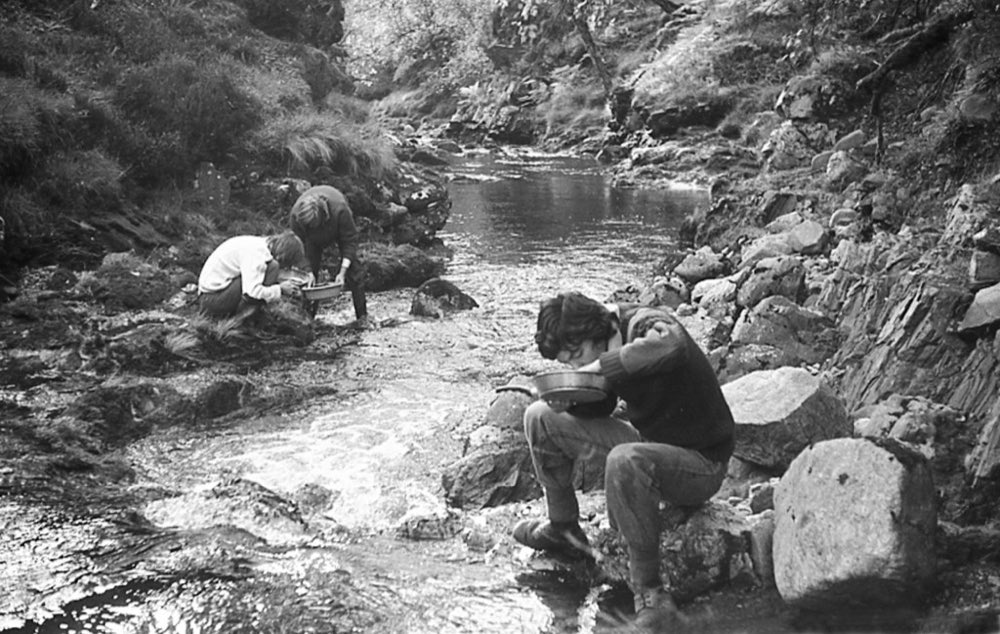
Most answers to this question say “you need permission” and stop there. That is true, and it leaves out the strange part. In the UK, gold and silver in the ground are not owned by whoever owns the land. They belong to the Crown, under rules that go back to the 1400s. So there are two separate permissions to think about, held by different people, and in most of the UK one of them says no.
Then there is the river itself, which may be protected in ways that have nothing to do with gold. That is the part that actually gets people prosecuted.
The short answer
- There is no law banning gold panning as such. Swirling gravel in a pan is not an offence anywhere in the UK.
- The gold is Crown property wherever you find it, including on your own land, except in a few places where the rights were granted away centuries ago.
- The Crown says no. The Crown Estate (England, Wales and Northern Ireland) and Crown Estate Scotland both state that they do not grant permission to remove gold by recreational panning.
- You need the landowner’s permission too, to be on the bank and in the water at all.
- The river may be protected. Disturbing salmon and trout spawning gravels is a criminal offence, and many of the best gold rivers are Sites of Special Scientific Interest. This is what people are actually fined for.
- A few sites are set up for it with permits sold by the landowner. They are the straightforward way to do it legally.
Why the gold is not yours, even on your own land
In England and Wales, the Crown’s claim to gold and silver comes from the Case of Mines in 1568, in which the courts held that mines of gold and silver belonged to the Crown by royal prerogative. These are the “Mines Royal”. Acts of 1688 and 1693 later stopped the Crown claiming ordinary copper, tin, iron and lead mines just because they contained a trace of precious metal, but they left the Crown’s right to the gold and silver itself in place.
Scotland reached the same result by a different route. Crown Estate Scotland’s position is that the Crown’s right to gold and silver there comes from statute rather than prerogative: the Royal Mines Act 1424, followed by an Act of 1592. Its answer to a freedom of information request on exactly this point notes that the 1688 and 1693 English Acts do not apply in Scotland.
In Northern Ireland, the Mineral Development Act (Northern Ireland) 1969 vested most minerals in what is now the Department for the Economy. Gold and silver were excepted. They remain with the Crown and are managed by The Crown Estate.
The practical upshot is the same everywhere: owning the land does not give you the gold under it. The British Geological Survey’s guide to UK mineral ownership makes the point from the other direction: a lease or permission from the Crown does not give you access to anyone’s land either. You need both.
There are exceptions. In Scotland, NatureScot notes that the rights belong to others in some areas, such as the estates of the Duke of Sutherland and the Duke of Argyll. Kildonan, the site of Scotland’s 1869 gold rush, is in Sutherland, which is why panning there works differently (see below).
Scotland, England and Wales each handle it differently
England and Northern Ireland: The Crown Estate
The Crown Estate’s published FAQ is blunt: “At The Crown Estate we do not grant permission for people to remove any gold by panning because of the damage gold panning can cause.” It adds that you need the landowner’s permission to get to the stream or river at all, and refers anyone who wants to understand the damage to the national nature conservation body for their area.
So in England, there is no Crown permission to be had for recreational panning. Gold is only found in small quantities in a few places here anyway, mainly in parts of Cornwall and Devon.
Scotland: Crown Estate Scotland, SEPA and NatureScot
Crown Estate Scotland’s statement on recreational gold panning takes the same line: where the Crown holds the rights, it does not grant permission for the removal of gold by recreational panning. It gives three reasons: it has no regulatory powers to police the activity, it would expect a royalty on any gold removed, and it has a statutory duty to get best value from Crown assets. The statement is careful to say that this does not restrict general access to the countryside, and that panning remains subject to environmental regulation by SEPA.
Scotland is the only part of the UK where the environmental regulator has published clear rules for panners, and they are worth knowing even if you pan elsewhere. SEPA’s national position says it will not normally require an authorisation for individuals panning by hand, provided they follow its good practice:
- Hand methods only. Sieves, pans, shovels, buckets, a portable sluice and a hand-operated pump. No powered pumps and no powered dredges.
- No panning between 1 November and 31 May where fish, including Atlantic salmon and trout, are present - that is, while they spawn and until the young emerge from the gravel.
- Put the riverbed back. Holes dug in the bed should be filled with the same material on the same day.
Panning beyond that standard needs a licence from SEPA. NatureScot’s position statement adds that if you follow SEPA’s guidance, you do not need a separate consent from NatureScot to pan within a designated site - but you still need the Crown’s permission to take the gold, and the landowner’s to be there.
Wales: Natural Resources Wales
Welsh gold has its own mystique, and the Dolgellau gold belt in Snowdonia is where most of the trouble happens. Natural Resources Wales does not permit gold panning on the land it manages, which includes the Coed y Brenin forest and its rivers. Its reason is the damage to the riverbed, including salmon spawning gravels.
It enforces this. In May 2022 a man caught panning at Coed y Brenin on four occasions the previous summer was ordered to pay just over £3,000 in fines and costs; NRW stressed that the spot was both a Site of Special Scientific Interest and a Special Area of Conservation. In September 2026 the same man was fined again, with more than £4,700 to pay in fines and costs, for panning at Pont Wen on the Afon Wen in Coed y Brenin in October and December 2024.
The river is the other problem
The Crown’s refusal is a matter of property. It is the river that turns panning into a criminal matter, and this applies whoever owns the gold.
Spawning gravels. In England and Wales, section 2(4) of the Salmon and Freshwater Fisheries Act 1975 makes it an offence to wilfully disturb any spawn or spawning fish, or “any bed, bank or shallow on which any spawn or spawning fish may be”. Clean river gravel is exactly where salmon and trout lay their eggs in winter, and exactly where panners dig. The Environment Agency lists it among the fisheries offences it can prosecute. Scotland’s SEPA guidance covers the same ground with its November-to-May closed period.
Sites of Special Scientific Interest. Many of the rivers with gold in them are SSSIs. Under section 28P of the Wildlife and Countryside Act 1981, it is an offence for anyone to intentionally or recklessly destroy or damage the features that make the site special. Digging into a protected riverbank or bed can be exactly that. You can check whether a river is designated on the government’s MAGIC map in England, through Natural Resources Wales, or on NatureScot’s SiteLink in Scotland.
Police take this seriously in Scotland too. Two men have been charged in the past over alleged illegal prospecting at the Birks of Aberfeldy, an SSSI in Highland Perthshire, and in June 2025 police in Tayside said they were investigating reports of panning carried out without the relevant licence in rural Perthshire, citing the risk to fish spawning.
Where you can actually do it legally
The clean way to pan for gold in the UK is at a place where the landowner sells permits or runs sessions, because the questions above have already been answered for you.
- Wanlockhead and Leadhills, Dumfries and Galloway. The Museum of Lead Mining sells gold panning licences for the Wanlock Water and Mennock Water on behalf of the Buccleuch Estate, which owns the land, and runs taster sessions and full-day courses. The museum’s site says it is closed until spring 2027, so contact it before you travel.
- Kildonan, Sutherland. The Suisgill Estate sells permits for panning the Kildonan Burn. Its site currently says panning is closed and permits are unavailable until 15 April 2027.
- Dolaucothi, Carmarthenshire. The National Trust’s Roman gold mine has a panning area in the mine yard where you can keep what you find. The Trust is explicit that panning is not permitted in the rivers and streams on the estate. The mine is closed for winter and reopens in spring 2027.
Everywhere else, you are starting from the landowner and working outwards: whose bank, whose bed, whether the Crown or a private estate holds the gold, and whether the river is protected. If any of those answers is no, so is the panning.
For the related question of finding gold objects - rings and coins rather than flakes in a river - see our guide to metal detecting for gold in the UK, which also covers specialist gold detectors.
The kit
Panning kit is cheap, and you do not need much to try it at a licensed site. A pan, a classifier (a sieve that sits on top of the pan and takes out the stones), and something to keep the flakes in is enough. These are the kits we recommend on our gold detecting page; we have not tested them ourselves.
Best starter kit: XP Gold Pan Starter Kit (about £35)
A 15-inch pan with a classifier and accessories, from the French maker of the XP Deus detectors. The easiest way to try panning without buying bits separately. Rated 4.6 stars from 81 Amazon UK reviews.
Best complete kit: XP Gold Pan Premium Kit (about £57)
Two pans, 10-inch and 15-inch, with two classifiers and an accessory kit. The big pan processes gravel; the small one cleans up the fine flakes at the end. Rated 4.6 stars from 100 reviews.
Cheapest way to try: Single 26cm Gold Pan (about £12)
Just the pan. Enough for a first session on a course where the rest of the kit is supplied, or to see whether you enjoy it before spending more.
Prices and ratings were last checked in November 2026 and will move. If you are panning in Scotland, note SEPA’s limits: a hand-worked sluice is fine, a powered pump or dredge is not.
Frequently asked questions
Is gold panning illegal in the UK? No. There is no law against panning itself. But the gold almost everywhere belongs to the Crown, which does not give permission for recreational panners to remove it, and disturbing riverbeds can break fisheries and conservation law. In practice, legal panning means a site where the landowner sells permits.
Do I own gold found on my own land? Usually not. Gold and silver are Crown property in England, Wales, Scotland and Northern Ireland regardless of who owns the land, except in a few places where the rights were granted to private estates long ago, such as parts of Sutherland and Argyll.
Do I need a licence to pan for gold in Scotland? Not from SEPA, as long as you follow its good practice: hand tools only, no panning from 1 November to 31 May where salmon or trout are present, and refill your holes the same day. You do still need the landowner’s permission, and Crown Estate Scotland does not grant permission to remove gold. Licensed sites such as Wanlockhead sell a permit that covers you.
Can I keep the gold I find? At Dolaucothi, the National Trust says you can keep what you find in its panning area. At other permit sites, read the permit terms before you start. Elsewhere, the gold belongs to the Crown or, in a few areas, to a private estate, and neither The Crown Estate nor Crown Estate Scotland permits recreational panners to take it.
Where can I pan for gold in England? There is no Crown permission available for recreational panning in England, and natural gold here is scarce. If you want to pan, the realistic options are the licensed sites in Scotland and the panning area at Dolaucothi in Wales.
Is gold panning allowed in Snowdonia? Not on land managed by Natural Resources Wales, which includes Coed y Brenin near Dolgellau. NRW has prosecuted panners there more than once, most recently in September 2026, partly because the rivers are protected sites with salmon spawning gravels.
What is the fine for illegal gold panning? It depends what you are charged with. The two Coed y Brenin prosecutions brought bills of just over £3,000 and just over £4,700 including costs. Damaging an SSSI or disturbing salmon spawning beds are separate criminal offences in their own right.
When is the gold panning season in Scotland? SEPA’s guidance rules out panning between 1 November and 31 May wherever salmon or trout are present, so on most rivers the season runs from June to October. Licensed sites publish their own dates, so check with the site before you travel.
Related guides
- Metal Detecting for Gold in the UK
- Metal Detecting Laws in the UK
- Can You Take Pebbles from UK Beaches?
- Is Magnet Fishing Legal in the UK?
- The Crown Estate, FAQs (gold panning)
- Crown Estate Scotland, Statement on recreational gold panning
- Crown Estate Scotland, FOI 075: Gold and silver rights
- SEPA, National gold panning position and good practice
- NatureScot, Gold panning position statement
- Salmon and Freshwater Fisheries Act 1975, section 2(4)
- Wildlife and Countryside Act 1981, section 28P
- Natural Resources Wales, Man fined over £3,000 for illegal gold panning
- British Geological Survey, UK mineral ownership