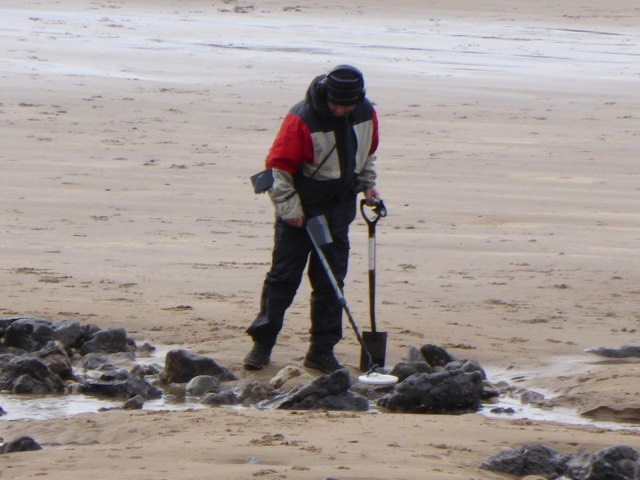
People search for “the beach detecting permit” as if there were one form to fill in. There is not. There is no national permit for metal detecting on a UK beach, and no single body that can give you one. Whether you need permission, and from whom, depends on who owns the particular strip of sand you are standing on - and a single beach can have two or three different owners between the dunes and the sea.
This page sets out exactly who those owners are and what each of them asks for, with real examples of the councils that run permit schemes. For the wider picture of which beaches are open to detecting, see our guide to whether you can metal detect on UK beaches.
The short answer
- There is no national permit. Nobody issues one for the whole coast.
- Crown Estate foreshore needs no application. In England, Wales and Northern Ireland, The Crown Estate gives detectorists a permissive right on its foreshore, free, subject to its terms. You do not need to apply. The one exception is the Thames.
- Some councils do want a permit. Swansea issues annual permits for Swansea Bay and most of Gower. North East Lincolnshire wants consent for each day you detect on Cleethorpes beach. Others need nothing at all.
- Private owners decide for themselves. That includes the Duchies of Cornwall and Lancaster, harbour authorities, estates and the National Trust, which does not allow detecting.
- The reporting duties apply everywhere, whoever owns the beach: possible treasure to the coroner within 14 days, wreck material to the Receiver of Wreck within 28.
Nobody owns “the beach” - three different owners
A beach is usually at least two separate pieces of land, and often three.
The foreshore is the strip between mean high water and mean low water - the sand the tide covers and uncovers twice a day. In England, Wales and Northern Ireland, The Crown Estate owns around half of it. The rest belongs to councils, harbour and port authorities, the Duchies of Cornwall and Lancaster, the National Trust and private estates.
The dry beach above the high-water mark - the soft sand, the shingle bank, the dunes - is a separate piece of land. It usually belongs to the local council or a private owner, and The Crown Estate’s permission for the foreshore does not cover it.
The seabed below mean low water is a third area again. Even where The Crown Estate owns it, its permission for detectorists stops at the low-water mark.
So “can I detect on this beach” is really two or three questions, and the answer can be yes on the wet sand and no on the dry.
The Crown Estate foreshore
This is the simplest case and the one most people are on. The Crown Estate’s published position is that anyone who wants to metal detect on its foreshore is granted a permissive right, subject to its terms and conditions. You do not need to apply for a permit and there is no charge.
The conditions that matter:
- Foreshore only - between mean high and mean low water. Not the seabed, not riverbeds, not other Crown Estate land.
- The Treasure Act applies, and the permission depends on you following it.
- Third parties can override it. Where The Crown Estate has leased a stretch of foreshore - to a harbour, a marina, a sailing club - or where the beach is a protected nature site, the leaseholder or designation may restrict detecting regardless.
- Finds above low water are generally the landowner’s property unless they are treasure.
- Not on the Thames. Detecting the Thames foreshore in London needs a separate permit from the Port of London Authority. See our Thames mudlarking permit guide.
To check whether a stretch is Crown Estate foreshore, use the Foreshore and Estuary Ownership Map linked from The Crown Estate’s metal detecting page. It covers England, Wales and Northern Ireland.
Why you still read about a “Crown Estate permit”. The Crown Estate used to issue a free permit on request. Older council documents still say so - Folkestone & Hythe’s metal detecting policy, adopted by its predecessor council in 2014, describes it, and the Isle of Wight Council’s guidance says a permit “is possible to obtain”. Forum threads from those years repeat it. Today there is nothing to apply for: the terms on The Crown Estate’s page are the permission.
Council byelaws and the permits that do exist
Councils own a great many seaside beaches, and each one sets its own rules. There are three broad approaches, and it is worth knowing which one you are dealing with before you go.
| Council and beach | What you need | How |
|---|---|---|
| Swansea Council - Swansea Bay and most Gower beaches | An annual permit | Online application with proof of NCMD or AMDS insurance and a current photo. Individuals only, not clubs. Valid for up to 12 months. |
| North East Lincolnshire - Cleethorpes beach | Prior consent for each day | Apply through the council’s MyNELincs self-serve portal. Detecting only in the mapped areas. A £100 fixed penalty if you cannot show consent when asked. |
| Isle of Wight Council - council-controlled beaches | No permit | Allowed on beaches the council owns or controls, but many are SSSIs where disturbance may not be permitted. |
| Cornwall Council - council-owned beaches | No permit | Allowed, except on beaches with an SSSI designation. |
| Folkestone & Hythe - council land | Generally not allowed | The policy adopted by its predecessor, Shepway, in 2014 permits detecting on council land only as part of an approved research programme, by permit. The foreshore is a separate matter. |
Swansea is the clearest example of a full permit scheme. Its terms require you to backfill holes and replace turf, make finds available for the council to see, and send in a record of your detecting at the end of the permit. Breaching any of the terms invalidates the permit.
North East Lincolnshire runs the strictest scheme we found. Cleethorpes beach is covered by a Public Spaces Protection Order, consent lasts a single day, and you need a new consent for every day you detect. Detecting in the borough’s parks and open spaces is not permitted at all.
The Isle of Wight and Cornwall show the other end: no permit on council beaches, with nature designations as the limit.
For any other council, search its website for “metal detecting” and for its beach byelaws or Public Spaces Protection Order, or ring the seafront team. Byelaw signs are usually posted at the beach entrance, and they take precedence over anything general you have read.
Where the Crown Estate is not the owner
Around half the foreshore in England, Wales and Northern Ireland belongs to someone other than The Crown Estate. The main ones:
- The Duchy of Cornwall owns a large share of the foreshore in Cornwall and the Isles of Scilly. In 2011 it proposed charging detectorists for an annual licence to detect its foreshore, which drew criticism at the time. We could not find a current published policy, so ask the Duchy directly before detecting a Duchy beach.
- The Duchy of Lancaster owns foreshore in the north-west of England. Again we found no current published policy. Older correspondence published by detectorists describes detecting as not generally permitted except on written application, so contact the Duchy office first.
- The National Trust does not allow metal detecting on its land, beaches included, except as part of approved archaeological projects. It owns long stretches of coast, including large parts of Gower.
- Harbour and port authorities control the foreshore within their limits and set their own rules. On the tidal Thames that is the Port of London Authority, which runs its own permit scheme.
- Private estates own stretches all round the coast. You need their permission exactly as you would on farmland; our permission letter template works for a foreshore owner too.
In Scotland, around half of the foreshore is managed by Crown Estate Scotland, and local authority archaeology services such as Aberdeenshire’s advise that no permit is needed to detect on it. The difference in Scotland is the law on finds rather than permission - see below and our Scotland guide.
In Northern Ireland, digging to search for archaeological objects needs a licence under the Historic Monuments and Archaeological Objects (Northern Ireland) Order 1995, and that applies on beaches as on farmland. Our Northern Ireland guide covers it.
Whoever owns the beach, three kinds of place need specific consent, and often will not get it: Sites of Special Scientific Interest and other nature designations, scheduled monuments, and military ranges.
What you must report
Permission to detect does not change what the law says about finds, and these duties apply on every beach.
- Treasure (England, Wales and Northern Ireland). Under the Treasure Act 1996, potential treasure must be reported to the coroner within 14 days of finding it or realising what it might be. That includes gold and silver objects over 300 years old and groups of old coins. Since 30 July 2023, it also includes objects at least 200 years old that are partly made of metal and give an exceptional insight into national or regional history, archaeology or culture. Your local Finds Liaison Officer can make the report for you. See what to do if you find treasure.
- Wreck. Anything from a ship found in or washed up from tidal waters - a porthole, a bell, cargo, timbers - must be reported to the Receiver of Wreck within 28 days under the Merchant Shipping Act 1995, whoever owns the beach.
- Scotland. Under Treasure Trove, all archaeological finds must be reported, not just precious metal.
- Modern valuables. A ring or watch that has clearly been lost recently belongs to somebody. Hand it in to the police.
One more thing that catches people on beaches: removing pebbles, sand or shingle can be an offence under the Coast Protection Act 1949 and local byelaws, which we cover in can you take pebbles from UK beaches. Digging to recover a find is not the same as taking the beach home, but it is worth knowing where the line sits.
Kit for the beach
Wet, salty sand gives single-frequency detectors a hard time, so a machine with a beach mode matters more than the permit. Our beach detector guide compares the options properly; this is the one we recommend to most people who detect both fields and beaches.
Best value for beach and land: Minelab Vanquish 340 (about £199)
A dedicated Beach mode and Minelab's Multi-IQ multi-frequency technology give it the stability on wet salt sand that single-frequency detectors at this price struggle with. The coil is waterproof but the control box is only water-resistant, so it is for the beach, not for wading. Rated 4.3 stars from 703 Amazon UK reviews.
Price and rating last checked in October 2026 and will have moved.
Frequently asked questions
Do I need a permit to metal detect on a UK beach? It depends who owns it. Crown Estate foreshore in England, Wales and Northern Ireland needs no application. Some councils require a permit - Swansea issues annual permits and North East Lincolnshire requires daily consent for Cleethorpes. Private owners, the Duchies and harbour authorities decide for themselves, and the National Trust does not allow detecting.
Is there a national metal detecting permit in the UK? No. No organisation issues a permit covering the whole coast, and anything sold as one is not a legal permission. Permission always comes from whoever owns the land.
Do I need a Crown Estate permit? No. The Crown Estate used to issue free permits on request, and older guidance still mentions them, but it now grants a permissive right on its foreshore subject to published terms. You do not need to apply, except to detect on the Thames, which needs a Port of London Authority permit.
How do I find out who owns a beach? Start with The Crown Estate’s Foreshore and Estuary Ownership Map, which covers England, Wales and Northern Ireland. If it is not Crown Estate land, the council’s seafront or property team usually knows who the owner is, and the Land Registry holds title for registered land.
Does a council permit cover the whole beach? Only the parts the council owns or controls. Below the high-water mark the foreshore may belong to The Crown Estate or someone else, and the council cannot give permission for land it does not own.
What happens if I detect without a permit where one is needed? On land with a byelaw or Public Spaces Protection Order you can be fined on the spot - North East Lincolnshire, for example, can issue a £100 fixed penalty. On private land without permission you are trespassing, and the owner can ask you to leave and has a claim to anything you found.
Do I need insurance to detect on a beach? Not by law, but some councils make it a condition of their permit. Swansea asks for proof of insurance from the National Council for Metal Detecting or the Association for Metal Detecting Sports. Our insurance guide compares the options.
Can I detect below the low-water mark? The Crown Estate’s permission stops at mean low water and does not extend to the seabed. Wading on the foreshore at low tide is within it; anything further out needs separate permission.
Related guides
- Can You Metal Detect on UK Beaches?
- Metal Detecting Laws in the UK
- What to Do If You Find Treasure
- The Best Beach Metal Detectors in the UK
- Can You Take Pebbles from UK Beaches?
- The Crown Estate, Metal detecting and drone flying
- Swansea Council, Metal detecting in Swansea
- North East Lincolnshire Council, Prior consent for metal detecting
- Isle of Wight Council, Metal detectors on Isle of Wight Council-controlled beaches
- Cornwall Council, Metal detecting on Cornwall Council beaches
- Folkestone & Hythe District Council, Metal detecting policy
- The Treasure (Designation) (Amendment) Order 2023
- Maritime and Coastguard Agency, Wreck and salvage law