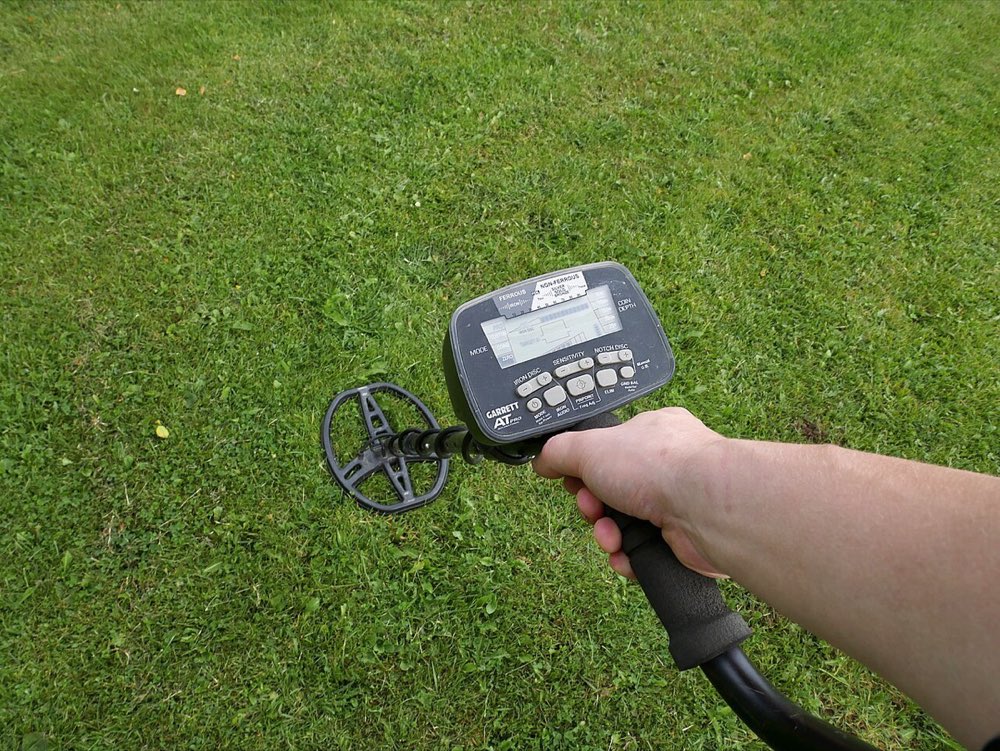
Almost every detector bought in this country gets its first swing on a back lawn. It is the obvious place: no permission to chase, no drive, and you can stop for a cup of tea. A garden is also a genuinely good place to learn, because you can take your time, dig carefully, and get used to what your machine is telling you before you stand in the middle of someone’s field.
What a garden will not do is make you rich. Expect bottle tops and nails, a few coins, and — if the house is old enough — some proper history.
What you will actually find
What comes out of a garden depends almost entirely on when the house was built and what the land was before.
A post-war or modern estate. Mostly rubbish: bottle tops, ring pulls, foil, nails, lead flashing offcuts, and the odd decimal coin. If the fields were farmed before the houses went up, you can still get older material at depth, but builders’ spoil tends to dominate the top foot.
A Victorian or Edwardian terrace. This is the sweet spot for garden detecting. Victorian households buried and burned their own rubbish in the garden, so you get clay pipe stems, pottery sherds, buttons, lead toys, pennies and halfpennies, and sometimes a silver threepence or a sixpence that went through a wash tub.
An old farmhouse or a cottage on an old lane. Anything is possible. Hammered coins, buckles, musket balls and trade tokens have all come out of gardens like these.
Any garden at all. Lost modern jewellery. Rings, earrings and watches come off hands in gardens constantly, and a surprising number of people only discover a detector is useful when they lose a wedding ring in the lawn.
Where you stand legally
Your own garden, as the owner. You can detect and dig as you like. No permission is needed from anyone.
If you rent. The land belongs to your landlord. Ask them first, and get it in writing if you can. Finds belong to the landowner unless you have agreed otherwise, which is the same arrangement detectorists use on farmland.
Treasure still applies. Owning the garden does not change the Treasure Act. If you find something that qualifies — broadly, gold or silver objects over 300 years old, groups of coins of that age, or certain other old metal finds — you must report it to the coroner within 14 days of realising. It is a criminal offence not to.
Scheduled monuments. A small number of properties have a scheduled monument inside the boundary, and detecting there without consent is an offence. If you live next to a castle, an abbey, a motte or a Roman site, check before you start.
Record what you find. You are not obliged to record non-treasure finds, but the Portable Antiquities Scheme will happily record anything over 300 years old, and a Finds Liaison Officer will usually identify things for you for nothing.
Before you dig: know what is under the lawn
This part is not exciting and it matters. Gardens are full of services that nobody marked on a plan: water pipes, the gas supply, the electric feed to a shed or a pond pump, phone and broadband ducting, and in older houses, lead pipework.
Work out roughly where things run — generally in a straight line from the house to the meter, the shed or the boundary — and stay off those lines. If you get a long, loud, continuous signal rather than a discrete one, that is usually a pipe or a cable, not a find. Leave it.
How to search a small garden properly
The whole point of a garden is that you can be thorough in a way you never can on a 40 acre field.
Grid it. Work in strips about a metre wide, up and down, then do the whole lawn again at 90 degrees. Two passes at right angles catch targets the first pass missed because of how the object was lying.
Slow down. Most beginners sweep far too fast. The coil should move at about the pace of a slow walk, kept low and level, with each sweep overlapping the last by about half a coil width.
Do not discriminate everything out. It is tempting to switch out iron so the garden goes quiet, but hammered coins, lead and small bronze sit near iron on the scale, and old iron objects are finds in their own right. Dig a good variety of signals while you are learning what your detector’s tones mean.
Go over the borders and the edges too. The strip along a boundary fence and the ground under a hedge are often the oldest undisturbed parts of a garden.
Digging without ruining the lawn
Garden detecting has one rule above all others: the lawn must look untouched when you have finished, or your detecting career ends with a conversation at the back door.
- Pinpoint the target so you know exactly where it is before cutting anything.
- Cut a plug, not a hole. With a trowel, cut a U or a horseshoe shape about 15cm across, going down through the root mat, and fold it back like a flap with the grass still attached on one side.
- Put the soil on a mat. A square of plastic or a finds mat keeps the soil off the grass, which is what actually makes the mess.
- Find the object with a pinpointer rather than by widening the hole.
- Put the soil back, fold the plug down, tread it in, and water it in dry weather. Done properly it knits back within a fortnight and is invisible within a month.
The kit for garden detecting
You do not need an expensive detector for a garden. You need one that handles mineralised British soil, tells iron from non-iron clearly, and does not weigh so much you give up after an hour.
A good first detector: Minelab Vanquish 340 (about £199)
Multi-frequency, which matters even on a lawn because it handles mineralised British soil without constant chatter. Simple enough to switch on and use, and good enough that you will not outgrow it the moment you get a permission.
A pinpointer: Garrett Pro-Pointer AT (about £117)
In a garden this is what keeps your holes small. It finds the exact spot in the plug so you are not widening the hole and shredding the turf. Waterproof, bright orange, and the one most UK detectorists own.
A finds pouch with a rubbish pocket (about £30)
One pocket for finds, one for the bottle tops and nails. The second pocket is the important one, because the alternative is leaving a pile of rusty rubbish on the lawn.
A decent trowel matters more in a garden than a spade does — you will be cutting plugs in turf rather than digging in a ploughed field. Our spade and digger guide covers both.
Cleaning and recording
Resist the urge to scrub anything. A gentle rinse and a soft brush is as far as you should go with a coin until you know what it is, because cleaning can destroy both the surface and the value. Our guide on cleaning metal detecting finds explains what is safe for which metal.
Keep a simple record as you go: what it was, where in the garden, and how deep. If something turns out to be old, that information is exactly what a Finds Liaison Officer needs.
When the garden runs out
A typical garden gives up most of its secrets in two or three sessions. When the signals dry up, the next step is land with history and space, which means asking permission. That is a smaller hurdle than most people think, and we have a guide to getting permission and a free permission letter template to make it easy.
Frequently asked questions
Can I keep everything I find in my own garden? Yes, unless it qualifies as treasure, in which case it must be reported to the coroner. If you rent, finds legally belong to the landowner.
Do I need to tell anyone I am detecting in my garden? No, assuming you own it and there is no scheduled monument on the land.
Will a cheap detector work in a garden? Yes. A £150 to £200 machine is plenty for turf and shallow finds. Where cheap detectors struggle is depth and mineralised ground, neither of which matters much on a lawn.
How deep should I expect to find things? Most garden finds sit in the top 15 to 20cm. Anything deeper is usually builders’ spoil or the original ground surface.
My detector screams constantly near the house. Why? Reinforcing in concrete, buried services, and the metal of the building itself. Work away from walls and paths, and lower the sensitivity if the ground is noisy.
Can I detect in a neighbour’s garden? Only with their permission. The same rules apply as for any other land you do not own.