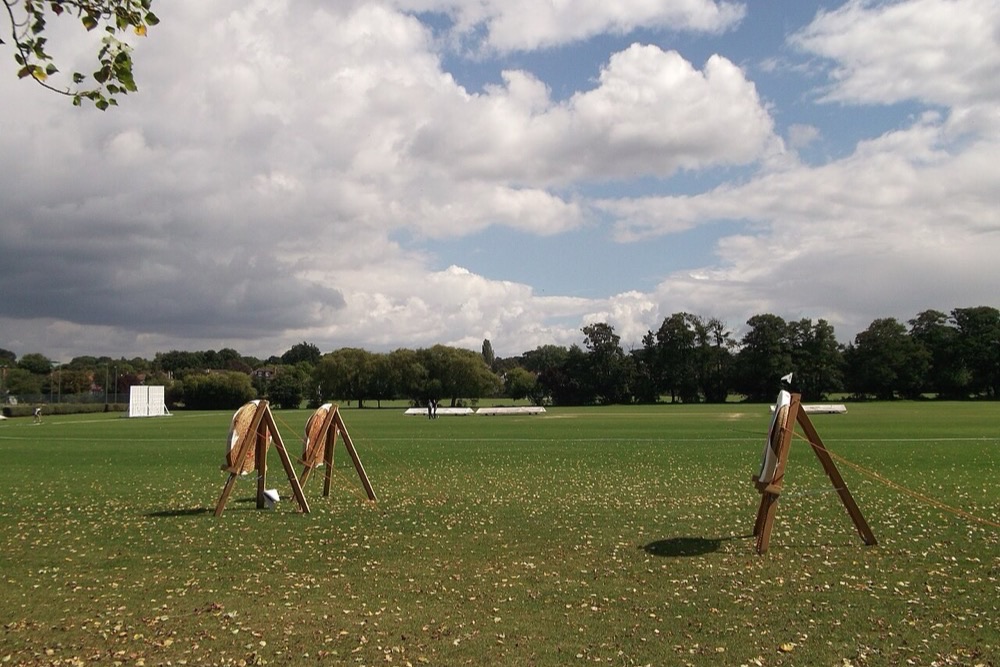
A metal detector is the most reliable way to find an arrow lost in grass. It doesn’t see the carbon shaft, but it picks up the metal parts: the point, the insert, any metal collars and, on aluminium arrows, the whole shaft. With a sensible setting, a slow sweep and a methodical search pattern, most lost arrows turn up in minutes.
This guide is for archers and clubs. It covers what a detector can and can’t find, how to set it up, how to search, and which detectors and pinpointers are worth buying.
Why a lost arrow matters
On your own land a lost arrow is just a lost arrow. Most UK clubs, though, shoot on shared ground: school fields, sports pitches, parkland and farmland. An arrow left in the grass is a hazard to whoever mows, plays or grazes there next, and it can cost a club its field. Glasgow Archers describes losing an arrow on a multi-use field as close to a disaster for a club.
That’s why many clubs now own a detector. Colwyn Bowmen in North Wales bought one for its outdoor shooting and says it has been invaluable for finding arrows that go astray.
What a metal detector picks up on an arrow
- Aluminium arrows are easy. The whole shaft is metal, so you get a strong signal.
- Carbon arrows with an aluminium core give a good signal from the core as well as the point.
- All-carbon arrows are the hard ones. The only metal is the point, the insert and any collars, so the signal is small and can come and go. Some clubs ask members to fit metal collars or add a strip of aluminium tape to arrows with very little metal.
- Wooden arrows with a steel point can be found from the point alone, but it’s a small target.
The single most useful thing you can do is test the detector on a matching arrow first. Lay one of the lost arrow’s quiver-mates on the grass and sweep over it, so you know what the signal sounds like and what the screen shows. Then you’re listening for that, and nothing else.
Setting up the detector
- Use all-metal mode, or keep discrimination low. Steel points read as iron on most detectors, and a mode that ignores iron can ignore your arrow. Glasgow Archers found aluminium arrows read as alloy, and carbon arrows with metal parts read as iron or nickel.
- Medium sensitivity. Arrows are on or just under the surface, so you don’t need full depth. A medium setting copes better with long grass and uneven ground and gives fewer false signals.
- Keep the coil flat and low. Set the shaft length so the coil sits level, just above the grass.
- Keep two detectors apart. Two machines close together interfere with each other, so if two people are searching, take different areas.
How to search
- Watch every arrow land. Note whether a miss went left or right, long or short. It’s far easier to search straight away than at the end of the session.
- Start behind the target. Most misses end up behind the boss. In dry, hard ground an arrow can skip and slide at a shallow angle into the grass roots, so it can be well beyond where it first hit. In soft, wet ground arrows usually stick in point first and are easy to see.
- Sweep across the line of flight. Walk slowly in straight lines across the direction the arrow travelled, overlapping each pass. An arrow is long, so a sweep about 45 to 60cm wide will catch part of it on every pass. Go too fast and you’ll miss it.
- Confirm with a pinpointer or your fingers. When you get a signal that matches your test arrow, narrow it down with a pinpointer, or part the grass by hand. A rake drawn across the turf, at right angles to the shooting line, also brings arrows to the surface.
- Ignore what doesn’t match. Playing fields are full of metal: drain covers, ring pulls, coins and tent pegs. If the signal doesn’t sound like your test arrow, move on.
A lost arrow procedure for clubs
Most clubs that shoot on shared ground have a written procedure. The common points are:
- An arrow register. Glasgow Archers has members record the arrows they shoot at each outdoor session, so a missing arrow is noticed before anyone goes home.
- Search straight away, while everyone remembers where it went, then again while others are scoring and once more at the end of the session.
- Nobody leaves an arrow behind unreported. If an arrow still can’t be found, mark the area and tell a committee member, so the club can search again or warn the landowner.
- Keep a club detector in the kit store with charged batteries, and show members how to use it.
Can you use a magnet instead?
A magnetic sweeper can work, but only if the point is magnetic. Plain steel points are. Tungsten points aren’t, and some stainless steel points aren’t either. Check one of your points with a fridge magnet before you rely on one. A metal detector finds any metal, magnetic or not, so it’s the better all-round tool.
The kit worth buying
You don’t need an expensive machine to find arrows. They’re shallow and you know roughly where to look. What matters is an all-metal mode, a comfortable weight and a battery that doesn’t go flat halfway through a search.
Best value club detector: SUNPOW Rechargeable (about £80)
The detector we recommend under £100. It has a built-in battery that lasts about 20 hours and charges by USB-C, so it's always ready in the kit store, an all-metal mode, a backlit screen and an 8-inch IP68 waterproof coil that doesn't mind wet grass. For finding arrows, that's everything you need.
For the last few centimetres: DR.ÖTEK Pinpointer (about £42)
A handheld pinpointer that buzzes when its tip is close to metal. Once the detector has found the area, a pinpointer finds the point in the grass in seconds. This one is waterproof to IP68 and has over 3,500 Amazon UK reviews averaging 4.5 stars. Some archers use a pinpointer on its own for arrows they saw land.
If the club wants one detector that does everything: Minelab Vanquish 340 (about £199)
The detector most often recommended to UK beginners. It sets itself up for the ground, so there's nothing to adjust when different members borrow it, and it's good enough to take detecting properly if anyone at the club catches the bug.
See our guides to the best detectors under £100 and the best pinpointers for more options.
Detecting on the club field
Searching for your own arrows is fine. Treasure hunting is different. If you want to detect the field for coins and old finds, you need the landowner’s permission first, just like anywhere else, and the usual rules on reporting treasure apply. See our guides to getting permission and the law.
Fancy the T-shirt? We've made a small range of archery slogans, including "I'm Not Lost I'm Looking For My Arrow" and "Gold Is The Only Colour", on T-shirts, hoodies, mugs and stickers. See the archery designs on Redbubble.
These are our own designs, printed and sold by Redbubble. We earn a small margin on each sale.
Frequently asked questions
Will a metal detector find a carbon arrow? Yes, from its metal parts: the point, insert and any collars, or the core if it has an aluminium one. All-carbon arrows give a smaller signal, so search slowly and test on a matching arrow first.
What’s the best metal detector for finding arrows? Any detector with an all-metal mode will do. Arrows are shallow, so you don’t need depth or advanced features. A rechargeable detector of around £80 plus a pinpointer is a good club setup.
Can I just use a pinpointer? For an arrow you saw land, often yes. For an arrow that skipped into long grass somewhere behind the target, a full-size detector covers the ground much faster.
Why can’t my detector find my arrow? The usual reasons are an iron-rejecting mode that ignores steel points, sweeping too fast or with the coil too high, or searching in the wrong place. Test on a matching arrow, slow down and widen the search behind the target.
Do magnetic arrow finders work? Only on magnetic points. Tungsten and some stainless steel points won’t be picked up. Test your points with a magnet first.